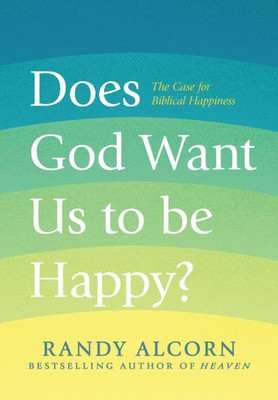
John Calvin said, “While all men seek after happiness, scarcely one in a hundred looks for it from God.” One reason is because we’re sinners. Another is because the average person wouldn’t imagine that happiness could be found in God. If they know Christians, they may or may not see any evidence that God makes people happy.
Many sense that the clock is ticking, and not only are they not happy enough, but even their present happiness is winding down. There’s a prevailing cynicism about whether lasting happiness can be found. Psychiatrist Thomas Szasz (1920–2012) said, “Happiness is an imaginary condition, formerly attributed by the living to the dead, now usually attributed by adults to children, and by children to adults.” Szasz implied that in our “enlightened” age, people no longer believe that those who have died live on in happiness. According to the naturalistic worldview, life ends at death. And even if those who reject a biblical worldview believed in an afterlife, they’d have no basis beyond wishful thinking to imagine it would be better than this one.
Unlike Szasz, Charles Spurgeon believed in Jesus and God’s Word, including 1 John 1:4: “These things we write to you, that your joy may be full.” Preaching on this passage, he said,
Come, let us be happy and joyful! If we have looked sad for a while, let us now be brightened by thoughts of Christ. . . . Let us not be satisfied until we have shaken off this lethargy and misery, and have once again come into the proper and healthy state in which a child of God should always be found, namely, a state of spiritual joy!
Jesus’ words “Ask . . . that your joy may be made full” (John 16:24) are remarkable. They indicate that joy is a major motive behind prayer. The Christian worldview doesn’t offer some vague, tenuous hope that there might be eternal happiness. It offers the solid promise of an eternal relationship with a happy God whose love is so great it sent Him to the Cross to secure our eternal righteousness and thus our never-ending happiness.
(Historically, there was no distinction between joy and happiness in the church and in the English language. Simply look up joy in a secular dictionary, say Webster’s Dictionary, and you’ll see it defined as happiness and, happiness defined as joy. They are synonyms with overlapping meanings. See this article for more.)
English Nonconformist minister Christopher Fowler (1610–1678) said that God’s children, because of “the love of God in Christ to them . . . have joy and comfort—that joy that angels cannot give, and devils cannot take.”
Jonathan Edwards said, “The enjoyment of [God] is the only happiness with which our souls can be satisfied. To go to heaven fully to enjoy God, is infinitely better than the most pleasant accommodations here. . . . [These] are but shadows; but the enjoyment of God is the substance. These are but scattered beams; but God is the sun. These are but streams; but God is the fountain.”
George Müller said, “I specially commend this point to the notice of my younger brethren and sisters in Christ. The secret of all true effectual service is joy in God.”
But is this “secret” known by young people being trained for church ministry and missions in Christian colleges and seminaries today? J. C. Ryle warned,
True religion . . . was intended to increase real joy and happiness among men. The servant of Christ . . . has no right to hand over innocent recreations and family gatherings to the devil and the world. The Christian who . . . walks the earth with a face as melancholy as if he was always attending a funeral, does injury to the cause of the Gospel.